Baghen: An Evaluation of an Old English Blackletter Typeface
In the vast landscape of digital typography, few styles command attention as immediately or evoke a specific historical period as effectively as Blackletter fonts. Baghen is one such typeface, designed to replicate the intricate aesthetics of Old English script. For designers, historians, and creatives seeking to infuse their projects with a sense of tradition, understanding the capabilities and limitations of Baghen is essential before integration. This evaluation explores what Baghen offers, where it fits within a design strategy, and how it compares to other typographic solutions.
Understanding the Design Philosophy of Baghen
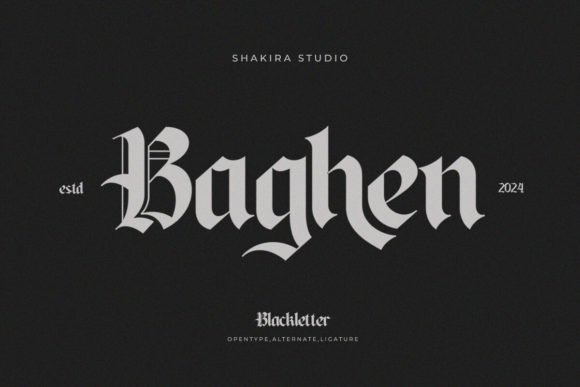
Baghen is not merely a collection of characters; it is a digital interpretation of the Gothic script that dominated European printing from the 15th through the 17th centuries. The font's architecture is defined by its vertical stress, angular strokes, and dense letterforms. Unlike modern sans-serif or humanist serif fonts, which prioritize legibility at small sizes and high speeds, Baghen prioritizes atmosphere and ornamentation. The "intricate details" mentioned in its description refer to the sharp serifs, the varying stroke widths, and the ornate flourishes that connect letters in certain contexts.
When evaluating Baghen, it is important to recognize that it falls squarely into the category of display typography. Its primary function is decorative rather than functional for body text. The design aims to transport the viewer back to an era of illuminated manuscripts and early printed broadsides. This makes it a powerful tool for establishing a specific mood, but it requires careful application to ensure it serves the project rather than overwhelming it.
Reasons to Consider Baghen for Your Project
There are several compelling reasons why a designer might select Baghen over more contemporary alternatives. The most significant factor is the immediate association with heritage and history. When a brand or event needs to communicate authenticity, age, or prestige, the visual language of Blackletter is often the most direct route.
- Historical Authenticity: For projects related to medieval history, Renaissance art, or traditional craftsmanship, Baghen provides a visual shorthand that aligns perfectly with the subject matter.
- Visual Distinction: In a market saturated with clean, minimalist designs, the bold and complex nature of Baghen stands out. It demands attention and can break the monotony of standard web or print layouts.
- Cultural Resonance: Certain industries, such as craft brewing, gothic fashion, or academic institutions with deep roots, utilize this style to signal membership in a specific cultural tribe.
Furthermore, the versatility of Baghen in large formats allows for creative manipulation. Because the characters are so distinct, they work exceptionally well when scaled up for headlines, logos, or signage where readability is less critical than impact.
Benefits and Tradeoffs
While the aesthetic appeal of Baghen is undeniable, adopting an Old English font involves navigating specific tradeoffs. The primary benefit is the ability to create a strong, memorable brand identity. A logo or invitation featuring Baghen can convey sophistication and timelessness instantly. However, this comes at the cost of legibility.
The dense structure of Blackletter fonts means that reading long passages of text becomes difficult, especially at smaller point sizes or on low-resolution screens. This is a crucial consideration for user experience (UX). If the goal is to communicate detailed information quickly, Baghen is likely the wrong choice. Additionally, the ornate nature of the font can sometimes clash with modern interface elements or clean layouts if not balanced carefully.
Another tradeoff is the potential for cliché. Because Blackletter fonts are frequently associated with specific themes—such as Halloween, heavy metal music, or generic "vintage" branding—there is a risk that using Baghen may make a project feel derivative rather than authentic. The designer must ensure that the context justifies the stylistic choice to avoid unintended associations.
Ideal Use Cases for Baghen
To maximize the effectiveness of Baghen, it should be deployed in situations where its decorative qualities are an asset rather than a hindrance. The following scenarios represent strong fits for this typeface:
- Invitations and Stationery: Weddings, galas, and formal events often benefit from the elegance of Baghen. On a printed card, the texture and detail of the font add a tactile sense of quality.
- Branding and Logos: For businesses like breweries, distilleries, or artisanal bakeries, a logo in Baghen can suggest tradition and hand-crafted quality.
- Signage and Headers: Large-scale signage, such as storefront signs or chapter headings in a book, allows the font to breathe. At these sizes, the intricate details are visible without compromising readability.
- Thematic Events: Conferences, exhibitions, or festivals focused on history, literature, or the arts can use Baghen to reinforce the theme visually.
In these contexts, Baghen acts as a focal point. It sets the tone for the entire piece, allowing other, more legible fonts to handle the informational content.
When to Consider Alternatives
Despite its strengths, there are many situations where Baghen may not be the optimal choice. Evaluating the project goals against the font's characteristics is vital. Alternatives should be considered in the following instances:
- Body Text and Long-Form Content: If the design requires paragraphs of text to be read comfortably, a serif or sans-serif font is necessary. Baghen creates too much visual noise for extended reading.
- Digital Interfaces: On mobile devices or websites where screen real estate is limited, the complexity of Baghen can lead to rendering issues and poor accessibility. Users with visual impairments may struggle significantly with this style.
- Modern or Minimalist Brands: If the brand identity focuses on innovation, speed, or simplicity, the heavy, historical weight of Baghen will likely feel incongruous.
- International Audiences: While recognizable in English-speaking cultures, Blackletter scripts can be confusing or carry different connotations in other languages and regions. A more neutral typeface might be safer for global campaigns.
Practical Decision-Making Insights
Deciding whether to integrate Baghen into a design workflow requires a strategic approach. First, define the primary objective of the communication. Is the goal to inform quickly, or to evoke a feeling? If the latter, Baghen is a strong contender. Second, consider the medium. Print generally handles the fine details of Blackletter better than digital screens, particularly on older devices.
It is also advisable to pair Baghen with a highly legible secondary font. Using a clean sans-serif for body text while reserving Baghen for headlines creates a harmonious contrast that leverages the strengths of both. Finally, test the design at various scales. What looks elegant at 48 points may become an illegible blob at 12 points. By anticipating these challenges, designers can ensure that Baghen enhances the project's narrative without compromising its functionality.
Ultimately, Baghen is a specialized tool best reserved for moments that demand a touch of historic sophistication. When used with intention and restraint, it brings a unique charm to designs, bridging the gap between past and present. However, like any powerful stylistic element, it requires a clear understanding of its limitations to be effective.