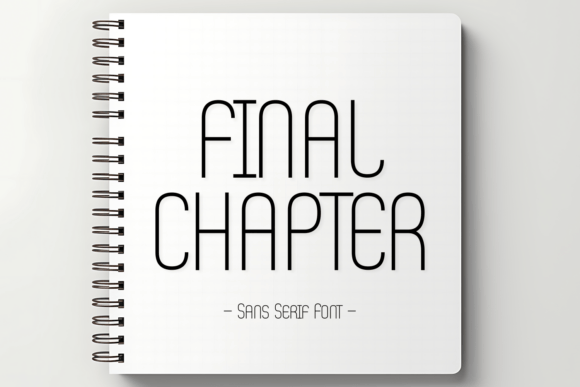
Final Chapter: A Modern Sans Serif for Clear Communication
In the crowded landscape of digital typography, where trends shift rapidly and novelty often overshadows utility, Final Chapter stands out as a deliberate return to clarity. It is not merely another geometric or humanist sans serif added to an overflowing library; it is a typeface engineered for readability and approachability in high-volume environments. For professionals ranging from UX designers to content marketers, the choice of font is rarely just aesthetic—it is functional. Final Chapter addresses the critical need for text that performs well across diverse mediums without demanding cognitive effort from the reader. Its design philosophy centers on simplicity, balanced shapes, and a friendly demeanor that bridges the gap between corporate professionalism and creative warmth.
The Design Philosophy Behind Final Chapter
At its core, Final Chapter is defined by its clean lines and open apertures. The letterforms are constructed with a logic that prioritizes legibility at small sizes while maintaining character at larger display scales. Unlike many modern fonts that rely on extreme contrast or idiosyncratic quirks to stand out, this typeface achieves distinction through consistency and balance. The strokes are uniform enough to create a smooth visual rhythm but possess subtle variations that prevent the text from feeling mechanical or sterile.
The "friendly" aspect of Final Chapter comes from its rounded terminals and slightly softened corners. These details soften the impact of the letters, making them feel approachable rather than authoritative or cold. This is a crucial distinction for brands and creators who wish to communicate transparency and trust. In an era where digital fatigue is common, a font that feels easy on the eyes can significantly reduce bounce rates and increase time-on-page metrics. The design team behind Final Chapter clearly understood that the best typography often goes unnoticed because it simply works, allowing the content to take center stage.
Key Characteristics and Visual Identity
- Simple Letterforms: The glyphs avoid unnecessary complexity, ensuring that characters like 'a', 'e', and 'g' are instantly recognizable even at low resolutions.
- Balanced Proportions: The x-height is generous, which enhances readability in body copy, while the ascenders and descenders provide enough vertical space to keep lines distinct.
- Neutral Yet Warm Tone: The font avoids the starkness of pure industrial sans serifs, offering a warmth that suits lifestyle brands, educational platforms, and personal blogs alike.
- Digital Optimization: The curves and counters are tuned specifically for screen rendering, minimizing pixelation on mobile devices and high-DPI displays.
Performance in Real-World Applications
Evaluating a typeface requires looking beyond static images to see how it behaves under pressure. Final Chapter demonstrates remarkable versatility when tested across various real-world scenarios. For web developers and UI/UX designers, the font's performance in long-form reading contexts is particularly impressive. When set in justified or left-aligned paragraphs, the spacing remains consistent, preventing the formation of distracting "rivers" of white space that can break a reader's flow.
Consider the use case of a professional blog or a news publication. Here, the primary goal is information delivery. Final Chapter excels here because its neutral voice does not compete with the headline or the imagery. It acts as a reliable vessel for the message. In contrast, for branding projects such as logos or packaging, the font offers enough personality to serve as a standalone identifier. The unique curvature of the capital 'F' and the specific shape of the lowercase 't' provide subtle hooks that make the brand memorable without being gimmicky.
Print applications also benefit from the font's robust construction. Whether used for a business card, a brochure, or a full-length report, Final Chapter maintains its integrity. The ink trap potential in its design suggests that it was considered for print workflows, ensuring that fine details do not bleed or disappear during the printing process. This dual capability—excelling in both digital and print environments—makes it a cost-effective choice for businesses looking to maintain a cohesive visual identity across all touchpoints.
Usability and Flexibility for Professionals
For entrepreneurs and freelancers, time is a currency, and tools must be efficient. Final Chapter reduces decision fatigue by offering a wide range of weights and styles that work harmoniously together. From light italics suitable for elegant pull quotes to bold caps for impactful headers, the family provides a complete toolkit for hierarchy management. This flexibility allows designers to establish clear visual structures without needing to mix multiple typefaces, which can often lead to cluttered and unprofessional results.
The usability of the font extends to its licensing and integration capabilities. While specific licensing terms may vary, the general trend for fonts of this caliber is to offer straightforward implementation for web and desktop use. For developers, the file sizes are optimized, meaning they do not bog down page load speeds—a critical factor for SEO and user experience. The font renders quickly, ensuring that users see crisp text immediately upon landing on a site.
Furthermore, Final Chapter adapts well to different languages and character sets. For global businesses or educators creating content for international audiences, the inclusion of extended Latin support ensures that the design language remains consistent regardless of the target market. This inclusivity is a significant strength, allowing the font to scale alongside a growing business or expanding project scope.
Who Benefits Most from Final Chapter?
- Content Creators and Bloggers: Those focused on long-form articles will appreciate the reduced eye strain and improved readability.
- Small Business Owners: Entrepreneurs seeking a professional yet personable brand voice can leverage the font's balanced nature to build trust.
- UI/UX Designers: Professionals designing interfaces need fonts that are legible at various sizes; Final Chapter fits this requirement perfectly.
- Educators and Publishers: The clarity of the typeface makes it ideal for e-books, course materials, and instructional guides where comprehension is paramount.
Practical Considerations and Limitations
While Final Chapter is a strong contender for many projects, it is not a universal solution. Its strength lies in its neutrality and friendliness, which means it may lack the aggressive edge required for certain industries like heavy metal music promotion, high-end luxury fashion, or avant-garde art installations. In those contexts, a more distinctive or experimental typeface might better convey the desired mood.
Additionally, because the font is designed to be approachable and simple, it relies heavily on good layout and spacing to shine. Poor kerning or cramped line heights can diminish its effectiveness, making it appear generic. Therefore, users should ensure they have a basic understanding of typographic principles or work with a designer who can maximize the font's potential. It is a tool that rewards careful application but can look flat if used carelessly.
Another consideration is the current saturation of sans serif fonts. With so many options available, standing out solely on typography is challenging. Final Chapter solves this by focusing on quality over quantity, but it requires pairing with strong imagery and thoughtful color palettes to create a truly unique brand identity. It is the foundation, not the entire house.
Long-Term Value and Strategic Fit
Investing in a typeface like Final Chapter is a strategic move for long-term brand health. Trends come and go, but the need for clear communication remains constant. By choosing a font rooted in timeless principles of readability and balance, organizations protect their visual identity from rapid obsolescence. The font's adaptability ensures it can evolve with the brand, whether that means shifting from a startup vibe to a corporate structure or expanding into new markets.
From an SEO perspective, using a fast-loading, highly readable font contributes indirectly to search rankings by improving user engagement metrics. Google's algorithms increasingly favor pages that provide a good user experience, and typography plays a non-trivial role in that equation. If users can read your content easily and stay longer on your page, search engines interpret this as a signal of quality.
Ultimately, Final Chapter represents a mature approach to design. It acknowledges that the most effective communication is often the simplest. For professionals who value substance over style, clarity over confusion, and reliability over flashiness, this typeface offers a dependable partner. It invites readers in, holds their attention, and delivers the message with precision. In a world of noise, Final Chapter provides the quiet confidence needed to get heard.