Aldest Tanigo: A Bold Western Typeface for Impactful Headlines
In the crowded landscape of digital and print design, finding a typeface that commands immediate attention without sacrificing readability is a persistent challenge. Aldest Tanigo emerges as a compelling solution for designers seeking a font with historical gravitas and modern structural integrity. It is not merely a decorative script; it is a bold and sturdy font style with a classic Western look that has found a renewed place in contemporary branding and editorial layouts. Its thick, slab serifs give it a strong and confident appearance, making it ideal for headlines and titles that need to stand out against complex backgrounds or minimalist white space.
For professionals ranging from marketing directors to independent publishers, the choice of typography often dictates the perceived authority of a message. Aldest Tanigo delivers on this front by combining the rugged aesthetic of 19th-century signage with the precision required for high-resolution screens and offset printing. This article evaluates the practical application, visual characteristics, and strategic value of Aldest Tanigo within professional workflows.
The Structural Foundation of Aldest Tanigo
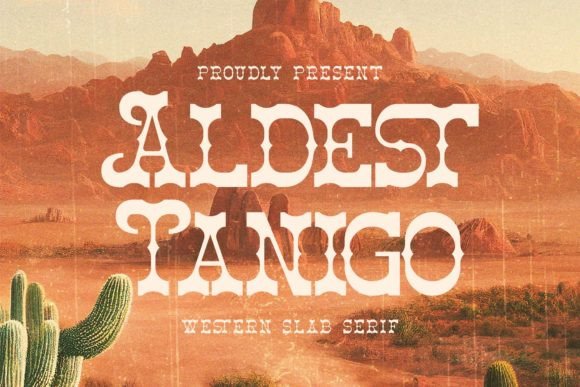
At its core, Aldest Tanigo belongs to the slab serif category, a classification defined by serifs that are block-like and of similar thickness to the main strokes of the letters. However, what distinguishes Aldest Tanigo from generic slab serifs like Rockwell or Courier is its specific weight distribution and stroke modulation. The font features heavy vertical stems and slightly lighter horizontal crossbars, creating a subtle rhythm that prevents the text from appearing flat or monotonous.
The "classic Western look" attributed to Aldest Tanigo is achieved through specific geometric adjustments. The letterforms possess a slight forward lean in certain characters, mimicking the hand-painted signs of the American frontier, yet they remain vertically aligned enough to maintain legibility at larger sizes. The terminals are squared off cleanly, avoiding the ornate flourishes common in display scripts. This restraint ensures that the font retains its impact even when used in condensed formats or tight kerning scenarios.
From a technical standpoint, the consistency of the stroke width is a significant asset. In many Western-style fonts, the transition between thick and thin lines can be erratic, leading to rendering issues on lower-quality printers or mobile devices. Aldest Tanigo maintains a robust uniformity that translates well across various media. Whether applied to a billboard, a business card, or a website hero section, the character shapes hold their definition without bleeding or pixelating excessively.
Strategic Applications in Branding and Media
The primary strength of Aldest Tanigo lies in its ability to function as a headline font. Its visual weight allows it to dominate a layout, effectively guiding the reader's eye to the most critical information. For entrepreneurs launching a brand in sectors such as craft beverages, outdoor apparel, or heritage-focused services, this typeface offers an instant association with durability, tradition, and authenticity.
Consider a scenario where a marketing team is designing a campaign for a new line of artisanal leather goods. Using a sleek sans-serif might feel too sterile, while a flowing script could appear overly delicate. Aldest Tanigo strikes the perfect balance. Its thick, slab serifs convey the sturdiness of the product, while the classic Western aesthetic hints at craftsmanship and timelessness. When paired with a neutral background and high-contrast imagery, the font elevates the perceived value of the offering.
Beyond print, Aldest Tanigo performs admirably in digital environments. As screen real estate becomes increasingly fragmented, headlines must compete for attention within milliseconds. The bold nature of this font ensures that titles remain readable even at smaller viewport widths. Web developers will appreciate that the font's distinct shapes reduce ambiguity between similar characters, such as 'I', 'l', and '1', which is crucial for user experience (UX) in navigation menus and call-to-action buttons.
- Editorial Design: Ideal for magazine covers, book titles, and feature headers where a sense of authority is required.
- Packaging: Effective for product labels that need to communicate quality and heritage, particularly in food and beverage industries.
- Event Promotion: Suitable for posters and flyers for festivals, concerts, or gatherings with a rustic or vintage theme.
- Digital Advertising: Works well in banner ads where large, impactful text is necessary to stop the scroll.
Evaluating Usability and Flexibility
While Aldest Tanigo is powerful, its utility is bounded by its inherent weight. Like any heavy slab serif, it is not designed for extended body copy. Attempting to use it for paragraphs of text would likely result in visual fatigue due to the density of ink coverage. The high x-height and thick strokes create a "wall of text" effect that hinders reading speed and comprehension over long distances. Therefore, its flexibility is best understood as specialized rather than universal.
However, within its intended scope—headlines, subheads, and short captions—the font offers surprising versatility. It supports both uppercase and lowercase usage, though it is often most effective when utilized entirely in caps for maximum impact. The spacing between characters (kerning) is generous enough to prevent crowding but tight enough to maintain a cohesive block of text. Designers should note that pairing Aldest Tanigo with other typefaces requires care. It pairs exceptionally well with simple, humanist sans-serifs or clean serifs that do not compete for visual dominance. Avoid pairing it with other display fonts or scripts, as the combination can quickly become chaotic.
Reliability is another key factor. In professional settings, a font must behave predictably across different operating systems and software suites. Aldest Tanigo is engineered to render consistently in major design applications, ensuring that what the designer sees on the monitor matches the final output. This reliability reduces the risk of costly reprints or last-minute web fixes, making it a safe investment for project managers concerned with timeline adherence.
Who Benefits Most from This Typeface?
The audience for Aldest Tanigo is diverse but united by a need for authoritative and distinctive visual communication. Small business owners in the hospitality sector, such as those running breweries, steakhouses, or boutique hotels, will find it particularly useful. It helps establish a brand identity that feels grounded and trustworthy without requiring extensive graphic elaboration.
Freelance designers and creative directors also benefit from having Aldest Tanigo in their toolkit. It serves as a go-to option for clients who want a "Western" or "Vintage" vibe but lack the budget for custom lettering. By providing a pre-designed solution that captures this aesthetic, designers can deliver high-quality results efficiently. Furthermore, educators and publishers working on history-related content or regional studies may find the font adds an appropriate thematic layer to their materials.
For serious hobbyists engaged in scrapbooking, custom merchandise creation, or personal branding, Aldest Tanigo offers a level of polish that generic free fonts often lack. Its professional construction ensures that DIY projects retain a sense of sophistication, bridging the gap between amateur effort and commercial-grade design.
Practical Limitations and Considerations
To provide a balanced evaluation, it is essential to acknowledge where Aldest Tanigo may fall short. Its boldness can sometimes overwhelm delicate imagery or intricate patterns. If a background image contains fine details, placing Aldest Tanigo directly over it without a solid overlay or drop shadow can lead to legibility issues. Designers must be prepared to manipulate opacity, contrast, or background elements to ensure the text remains clear.
Additionally, the font's distinct personality means it is not suitable for every brand voice. Companies aiming for a futuristic, minimalist, or highly corporate image should likely avoid it. The Western connotations are strong and can clash with brands that wish to project neutrality or high-tech innovation. Context is paramount; using Aldest Tanigo for a fintech startup or a medical practice would likely send mixed signals to the target audience.
Finally, while the font is sturdy, its file size can be larger than standard system fonts due to the complexity of the glyph outlines. For web implementations where load speed is a critical performance metric, optimizing the font file or using variable font technology where available is recommended to prevent slowing down page rendering times.
Conclusion on Long-Term Value
Aldest Tanigo represents more than just a stylistic trend; it is a functional tool for designers who understand the power of typographic hierarchy. Its bold and sturdy nature, combined with a classic Western aesthetic, provides a unique visual language that resonates with audiences seeking authenticity and strength. While it is not a one-size-fits-all solution, its effectiveness in headlines and titles is undeniable.
For professionals evaluating whether to incorporate this typeface into their workflow, the decision should hinge on the specific needs of the project. If the goal is to create a memorable, confident statement that stands the test of time, Aldest Tanigo offers significant value. Its consistent performance, reliable rendering, and distinct character make it a worthy addition to any serious design library. By understanding its strengths and limitations, creators can leverage Aldest Tanigo to produce work that is not only visually striking but also strategically sound.